The wiring in a house gets buried behind drywall and stays there for 50 years, which means whatever gets done wrong at rough-in becomes somebody's expensive problem later. Homeowners find out when there's nowhere to plug in the coffee maker, or the island has no outlet, or the whole media wall needs a circuit that nobody ran. Builders find out when a buyer walks through the house and starts pointing things out. Custom homebuilders, developers, and homeowners can count on Blueprint Electric for residential new construction in and around Leesburg, FL, to get the plan right before the walls close up.
Blueprint Electric is a state-certified electrical contractor based in Leesburg, FL, run by Shae and Ray, a pair of local guys with three decades of combined electrical work behind them. Our crews wire new homes throughout Central Florida, covering custom and luxury builds, production communities, spec homes, and barndominiums. The scope runs from underground and trenching through service, panels, rough-in, low voltage, smart home systems, architectural and landscape lighting, and final trim. Builders, general contractors, designers, and homeowners all work with us directly, and our scheduler and permit tech keep inspections and paperwork on track behind the scenes.
The complaint we hear most often from homeowners has nothing to do with anything being broken. The house works fine. There just aren't enough outlets in the kitchen, the pantry has no light, the switch for the back porch sits behind the door, and the office needs three more circuits than it got. Unfortunately, the walls are closed, and every fix or update means cutting into fresh paint.
Almost always, this traces back to the electrical plan being treated as an afterthought. Somebody wired the house to the minimum code, which is a floor, not a target, and nobody sat down with the homeowner to talk through how they'd actually live in the space. Furniture placement, where the Christmas tree goes, whether the garage will eventually hold an electric vehicle (EV) or a workshop—none of that made it into the drawings.
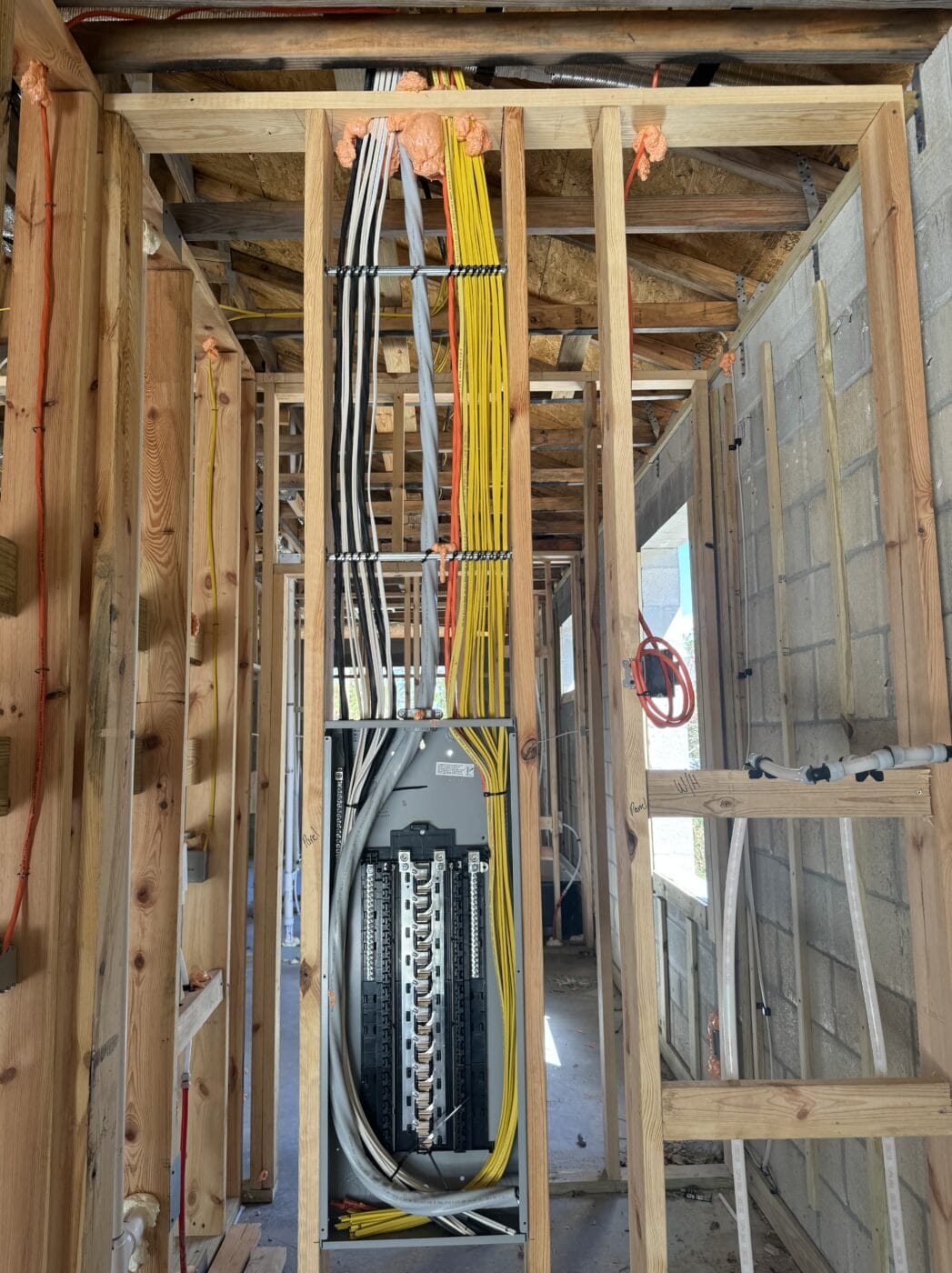
The way a residential electrician on our crew handles it is to walk the house at rough-in with whoever's making decisions, plans in hand, before a single wire gets pulled. We mark switch heights and locations on the studs, talk through outlet placement room by room, flag anything the plan missed, and run the low-voltage and smart-home rough-ins simultaneously so they're there when you want them. Anything that changes gets caught while changing it costs almost nothing.
The house that comes out the other end fits the people living in it. Switches land where your hand reaches, the kitchen has power where you need it, and the panel has room left over for the pool heater or the charger you'll add in three years. Nobody's cutting drywall six months after closing.
Here's a look at the kinds of home projects our crews take on throughout Central Florida.
Barndos have become popular around here, combining residential and shop-style elements in one building. Our scope usually starts underground with trenching and running power to the site, then covers the service and panel, living-area wiring, and heavier circuits for workshops, welders, compressors, and equipment.
Big custom homes are where our crews do some of their most interesting work, and plenty of those builds run well into the millions. Detailed planning begins in preconstruction with the builder, designer, and homeowner, covering architectural and landscape lighting, smart home and automation systems, whole-house audio rough-ins, pool and spa equipment, outdoor kitchens, generators, and EV charging. Every phase, from underground work to final trim, is handled by the same crew, so there's no gap between what was planned and what was built.
Volume builders need the same house wired the same way, over and over, on a schedule that doesn't slip. Our crews run production communities and have wired projects as large as 400 homes, moving through underground, rough-in, trim-out, and final across multiple houses at once. Developers get consistent results without babysitting the schedule, since our permit tech keeps county paperwork from stalling a phase.
Builders putting up spec homes need new residential electrical work that looks good, holds up under inspection, and is completed fast enough to keep carrying costs down. Efficient scheduling and clean workmanship are what we bring to these, along with the kind of detail a buyer notices during a walk-through. The finished house hits the market with an electrical system the builder can stand behind.
Losing power for three days with a fridge full of groceries gets old fast. Our generator installation service includes an outdoor standby unit that starts automatically within seconds of an outage. As a Generac dealer who also installs Kohler, our crew handles sizing, placement, transfer switches, permitting, and the final inspection.
Most houses were wired for how people lived when they were built, which explains the extension cords running across the living room. Our residential electrical installations and home upgrades fix that by adding the outlets, circuits, and dedicated lines you actually need for hot tubs, EV chargers, home offices, and workshops.
That gray box in the garage decides how much your home or building can actually handle, and a lot of them around here are running on borrowed time. Electrical panel and service upgrades give you the capacity to add what you want without tripping breakers, and our team coordinates with the utility when the meter or service size needs to change.
Renovations tend to reveal surprises, and old wiring behind a wall is near the top of the list. Remodeling and renovation electrical work is where we bring outdated systems up to code while wiring in whatever the new plan calls for, from kitchen and outdoor kitchen builds to attic conversions, garage additions, and barn projects.
Good lighting makes a kitchen easier to cook in, a storefront easier to shop in, and a parking lot safer to walk across at night. A lighting installation from our crew ranges from can lights and specialty fixtures to landscape, dock, and pole-mounted LED work, with controls set up so nothing burns energy when nobody's around.
Something’s wrong when a switch feels warm, an outlet stops working, or half the house goes dark for no clear reason. Tracking down the cause is the real skill in electrical repair, and our technicians would rather spend the extra 20 minutes finding it than swap a breaker and leave you with the same issue next month.
Downtime hits a business where it hurts, so having an electrician who answers the phone and shows up matters more than most owners realize until they need one. Our commercial electrical services cover ground-up buildings, tenant spaces, equipment hookups, troubleshooting, and everything in between for shops, offices, gyms, and food service across the area.
Ground-up projects live and die by whether each trade hits its window, and electrical sits right in the middle of that sequence. Our crew handles commercial new construction for offices, retail centers, restaurants, warehouses, and metal buildings, taking on the full scope from underground to final trim, so general contractors have one number to call.
An empty suite doesn’t pay anybody, and the electrical is usually what decides whether a space opens on time. Our commercial tenant build-outs and renovations cover load calculations before demo, new circuit layouts, panel and service modifications, lighting packages, and equipment hookups for restaurants, retail, offices, and everything else that moves into a commercial space.
Everything above grade waits on what goes in the ground first, and fixing an underground mistake after the asphalt is down gets expensive fast. Commercial site electrical and underground infrastructure is where our crews handle trenching, conduit and distribution, transformer pads, parking lot and street lighting, site controls, and RV park construction, plus the utility coordination, which usually has the longest lead time on a project.
Homebuilders and homeowners around Central Florida pick us for reasons that have less to do with wire and more to do with how a job runs.
Between two owners and a crew of licensed electricians and apprentices, there's a long track record behind every house we touch.
Send over the drawings, and we'll price the job and flag anything that looks off, no charge and no obligation.
Financing helps homeowners manage the electrical portion of a build without draining their budget before the house is finished, and military members receive a discount.
Our crew grew up here, so the houses we wire are in neighborhoods where we run into our customers at the grocery store.
Underground, service, rough-in, low voltage, lighting, generators, and EV charging all come from us, so there are no gaps between trades and no finger-pointing.
Our crew meets you on-site with the plans so outlet and switch placement can be finalized while it's still marked on the studs.
Every new home in Florida requires an electrical permit, and the wiring goes through at least two inspections, one at rough-in before drywall and another at final before anybody moves in. Lake County, Sumter County, and the individual cities each run their own review process, so the timeline shifts slightly depending on where the house is located. Your electrical contractor should pull the permit and schedule those inspections as part of the job.
Most new homes need roughly two to five days for rough-in and another two to four for trim-out, with the underground and service work adding a day or so on either end. Bigger custom homes with detailed lighting plans, smart systems, and outdoor spaces can stretch that considerably. The bigger factor is usually the gap between phases, since the electrician has to wait on framing, then on drywall and paint, before coming back.
A 200-amp service serves most new homes in Central Florida, though larger houses with pool equipment, outdoor kitchens, EV chargers, or a detached shop often require 320 amps or a second panel. Running the AC nearly year-round already puts a bigger baseline load on Florida homes than you'd see up north. Sizing the service with some headroom costs very little during construction and saves a lot later.
Walk the house with your electrician before the wiring gets pulled, and talk through furniture placement, where the TV goes, how you'll use the garage, and anything you might add in a few years, like a hot tub, a generator, or an EV charger. Switch heights, outlet locations, and extra circuits cost almost nothing to change while everything's still open studs. Once drywall covers it, every change means cutting into finished work.
Rough-in is the only cheap time to run low-voltage for networking, security cameras, audio, and automation, since those cables follow the same path as the power wiring. Wireless devices work fine for some things, but hardwired connections offer greater reliability for cameras, access points, and anything that carries video. Running spare conduit to a few key spots also leaves room for whatever technology shows up after the house is finished.
FAQs reviewed by Shae Arce, owner of Blueprint Electric, a licensed and certified electrician in Leesburg, FL.
Contact us, and we'll walk through what your house needs before anybody starts pulling wire. Estimates are free, and there's no pressure to book.
Address: Leesburg, FL 34748
Phone: 352-933-2732
Business Hours:
Mon - Sat: 7:00 AM to 5:00 PM
Sun: Closed